

Business systems are documented, repeatable, transferable processes that allow your company to operate without depending on any single person, including you. When you design business systems early stage, you give your startup the structural backbone it needs to grow without breaking. Most founders delay this work, assuming systems are for bigger companies. That assumption costs them months of rework, lost revenue, and burnout. The frameworks covered here, including SOPs, business architecture, and lean planning, apply from day one and scale with you.
How to design business systems early stage: choosing your first process
The single most common mistake founders make is trying to systemize everything at once. The right starting point is what practitioners call a "high-stakes process," defined as any workflow that visibly breaks when the owner steps away. Customer onboarding, invoicing, and fulfillment are the three processes that most early-stage startups should address first, because each one directly touches revenue and customer experience.
To select your first system, score each candidate process against five questions:
- Does this process touch revenue directly?
- Am I the only person who knows how to run it?
- Does it occur at least once a month?
- Has it failed or caused problems in the last 90 days?
- Could a capable hire perform it if I wrote it down?
Any process that scores "yes" on three or more of those questions is your starting point. This scoring method cuts through the noise of competing priorities and gives you a defensible, data-driven reason to act on one workflow before any other.
Pro Tip: Pick one process and finish documenting it before touching a second. Partial documentation across five systems is worth less than one complete, tested SOP.

The decision tree logic here is straightforward. If a process breaks visibly without you and recurs regularly, it belongs in your first system design sprint. If it's rare or low-stakes, it can wait. Founders who apply this filter consistently report that customer onboarding is almost always the first system they build, because a broken onboarding experience destroys retention before the product even gets a fair chance.
Step-by-step: how to document and validate a business system
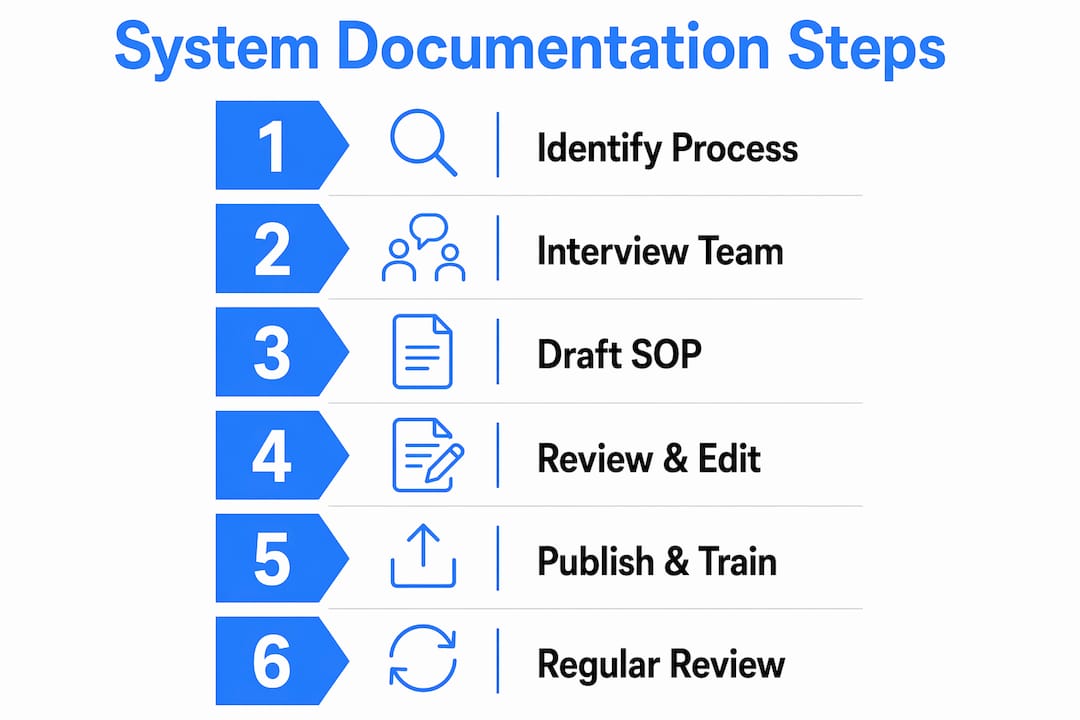
Documenting a process well is harder than it sounds, because most founders write down what they think happens rather than what actually happens. A documentation workflow that records real operations by interviewing the people doing the work, not just the manager describing it, produces SOPs that hold up under real conditions.
Follow this six-step method:
- Name the desired outcome. Write one sentence describing what "done" looks like. "Client receives login credentials and completes first session within 24 hours of payment" is a usable outcome statement. "Onboard client" is not.
- Capture current reality. Run a 30 to 60 minute interview with whoever currently performs the process. Ask for exceptions, edge cases, and workarounds. Record the session.
- Define the trigger and the owner. Every system needs a clear start condition ("payment confirmed in Stripe") and a named role responsible for execution.
- Write numbered steps with action verbs. Each step should begin with a verb: "Send," "Upload," "Confirm," "Tag." Assign a responsible role to each step.
- Run a live test. Hand the document to someone unfamiliar with the process and watch them follow it without coaching. Every point of confusion is a gap to fix.
- Schedule a 90-day review. Systems rot without a review schedule. Block the calendar date before you publish the SOP.
The sections most founders skip are the ones that matter most for long-term usability. Standard SOPs require decision points, exception handling, and version history to remain audit-ready and actually useful when edge cases arise. A decision point looks like this: "If the client does not respond within 48 hours, escalate to the account manager and log in the CRM." Without that branch, the SOP fails the first time reality deviates from the ideal path.
Common pitfalls to avoid during SOP creation:
- Writing steps from memory instead of observation
- Omitting the "done" definition at the end of the process
- Skipping version history, so no one knows which draft is current
- Failing to assign a single owner per step
- Treating the first draft as final without a live test
Pro Tip: Use an AI assistant like ChatGPT or Claude to generate a first-draft SOP from your recorded interview transcript. Then edit for accuracy rather than writing from scratch. This cuts documentation time by more than half.
Why business architecture makes your systems scalable
Business architecture is not the same as technical system design. Business architecture connects your strategy, your core capabilities, and your processes to the tools and platforms you choose. Aligning system design with business capabilities produces solutions that are stable, reusable, and flexible enough to grow with the company rather than requiring expensive rebuilds every 18 months.
For an early-stage startup, this means asking a different set of questions before you buy software or build a workflow. Instead of "what tool solves this problem today," you ask "what capability does this system need to support, and will this tool still serve that capability when we are three times our current size."
"Business architecture forces clarity on workflows and decision points early, which improves integration and reduces costly redesign or patchwork solutions." — pmprocesses.com
The practical benefits of applying business architecture principles at the early stage include:
- Reduced fragmentation. Systems built around capabilities rather than individual pain points connect to each other naturally instead of requiring custom integrations later.
- Better decision-making. When your team understands which capability a system serves, they make better choices about exceptions and escalations without asking you.
- Faster onboarding. New hires understand how their role connects to the broader operation when systems are organized by capability rather than by the tool that happens to run them.
- Lower redesign costs. Business systems planning that sequences investments by cost and time criteria prevents the expensive patchwork that kills startup momentum.
The most common failure mode here is tool-first thinking. A founder buys a project management platform, builds workflows inside it, and then discovers six months later that the tool does not integrate with their CRM. The capability was "project tracking." The tool was a downstream decision. Reversing that order saves significant time and money.
Lean business planning to support scalable system design
A lean business plan is a one-page, living document that replaces the traditional 40-page business plan for early-stage companies. Lean plans can be completed in under an hour and serve as the strategic anchor that tells you which systems to build next. This matters because system design without strategic alignment produces efficient processes that serve the wrong priorities.
The contrast between lean and traditional planning is stark:
| Factor | Traditional business plan | Lean business plan |
|---|---|---|
| Length | 20 to 40 pages | One page |
| Time to complete | Weeks to months | Under one hour |
| Update frequency | Annually | Monthly or as strategy shifts |
| Primary use | Investor presentations | Internal decision-making |
| System design role | Indirect, if at all | Direct: guides which systems to prioritize |
The lean plan works for system design because it forces you to state your strategic targets in plain language. Once you know your revenue model, your customer segment, and your 90-day milestones, you can rank your process backlog against those targets and build the systems that move the right numbers.
Pro Tip: Review your lean plan at the start of every month and ask one question: "Does our current system backlog serve this strategy?" If the answer is no, reprioritize before building anything new.
Tools like Notion, Airtable, and Google Docs all work for lean planning. The format matters less than the habit of treating the plan as a decision filter rather than a document you file and forget.
Common mistakes in early-stage business system design
The founders who struggle most with business process optimization share a predictable set of habits. Recognizing these patterns early saves months of wasted effort.
- Systemizing too many processes at once. Three half-built SOPs deliver zero operational value. One complete, tested system delivers immediate relief.
- Documenting the ideal, not the actual. If your SOP describes how the process should work rather than how it does work, it will fail the first time someone follows it.
- Skipping decision points. Every real process has branches. A document that only covers the happy path is incomplete by definition.
- Ignoring version control. Without a version number and a date on every SOP, teams default to tribal knowledge within weeks of publication.
- Building systems around tools. Software changes. Capabilities do not. Design the process first, then select the tool that supports it.
- No review schedule. Early-stage founders should prioritize learning velocity and build foundational operating systems before scaling. A system that is not reviewed becomes a liability faster than you expect.
Team buy-in is its own challenge. The people who perform a process daily will resist a document that does not reflect their actual experience. Involve them in the capture phase, not just the review phase. When operators co-author their own SOPs, adoption rates climb and the documentation quality improves simultaneously.
Pro Tip: Assign a "system owner" to every SOP you publish. That person is responsible for flagging when the document no longer matches reality. Without a named owner, no one feels accountable for keeping it current.
Key takeaways
Designing business systems early is the single highest-leverage investment an early-stage founder can make, because one well-built system frees the time and mental bandwidth needed to build the next one.
| Point | Details |
|---|---|
| Start with one high-stakes process | Choose the workflow that breaks most visibly without you, typically onboarding, invoicing, or fulfillment. |
| Document reality, not ideals | Interview operators and record actual workflows before writing a single step in your SOP. |
| Include decision points and exceptions | SOPs without branching logic fail the first time a real edge case appears. |
| Align systems with business capabilities | Design around what your business needs to do, not around the tool you currently use. |
| Review every 90 days | Systems that are not maintained become inaccurate faster than most founders expect. |
What I've learned from watching founders build systems too late
I have worked with enough early-stage founders to recognize the pattern immediately. They build fast, they sell hard, and they assume systems are something they will sort out "once things settle down." Things never settle down. The chaos compounds.
The founders who break out of that cycle share one habit: they document one process completely before moving to the next. Not perfectly. Completely. There is a difference. A complete SOP has a named owner, a trigger, numbered steps with action verbs, at least one decision branch, and a review date. A perfect SOP does not exist, and chasing it is how documentation projects die in draft folders.
Writing SOPs early accelerates startup maturity more than premature scaling or optimization experiments. That finding aligns with everything I have observed. The founders who build systems before they feel ready are the ones who can hand off work, take a week away from the business, and return to find things running. The ones who wait are still the single point of failure two years in.
My strongest advice: own the first system design yourself. Do not delegate the documentation of your core processes to a new hire or a contractor who does not understand the business yet. Sit with the operator, record the session, write the first draft, and run the live test. Once you have done it once, you understand what good looks like, and then you can delegate the next one with clear standards.
— james
How Firstboroughconsulting helps founders build systems that scale
Building systems without a framework is how founders end up with a folder full of half-finished SOPs and no operational relief. Firstboroughconsulting works with early-stage entrepreneurs to design and implement business systems that run without requiring your constant presence.

The Firstboroughconsulting approach centers on blueprints, playbooks, and strategic kits built specifically for founders who want to scale without becoming the bottleneck. Whether you are designing your first customer onboarding system or mapping out a full operational architecture, the systems and strategy resources at First Borough Group give you the structure to move faster with less rework. Founders who have used these frameworks report significant shifts in how they think about operations and growth.
FAQ
What is a business system in a startup context?
A business system is a documented, repeatable process that any competent team member can execute without asking the founder for guidance. It includes a trigger, numbered steps, decision points, and a defined "done" state.
How many systems should an early-stage startup build first?
Start with one. Documenting one high-stakes process completely delivers more operational value than partial documentation across multiple workflows.
What is the difference between an SOP and a business system?
An SOP is the written document that describes a process. A business system is the broader structure that includes the SOP, the tools that support it, the owner responsible for it, and the review schedule that keeps it current.
How often should startup SOPs be reviewed?
Every 90 days at minimum. Systems that are not reviewed on a fixed schedule drift from reality quickly, especially in early-stage companies where processes change frequently.
Do I need business architecture knowledge to design startup systems?
No formal training is required. The core principle is to design processes around what your business needs to accomplish, not around the software you currently use. That single shift prevents most of the expensive redesign work that plagues fast-growing startups.