

A business operating system is defined as a standardized, enterprise-wide set) of processes and practices that align daily work with strategic objectives by addressing the why, what, and how of execution. It is not software. It is not a CRM or a project management app. A business operating system (BOS) is the coherent framework that determines how your company actually runs, from how leads become clients to how decisions get made without you in the room. Frameworks like EOS Worldwide, the Danaher Business System, and fractional COO methodologies described by Simon Wakeman all share one core premise: without a structured operating system, growth creates chaos instead of scale.
What is a business operating system and what does it actually do?
A BOS is the structured layer integrating workflows, tools, data, ownership, and governance so work moves reliably from step to step. Think of it as the operating system on a computer. Your software apps (Salesforce, Slack, Notion) are the programs. The BOS is the underlying OS that makes them work together with purpose and predictability. Without it, your tools are just expensive islands of activity.
The business operating system definition goes beyond documentation. It covers five interconnected layers that every functioning business needs:
- Workflows that connect demand generation, service delivery, and reporting in a continuous loop
- Ownership and decision rights that define who is accountable for each step, so nothing falls through the cracks
- Governing rules and processes that keep operations consistent regardless of who is on the team that week
- Reporting layers that give leadership a trusted, real-time view of operational health
- Tool integration that supports the system without replacing it
Explicit roles, handoffs, and decision rights are not optional extras. Without them, even the best-documented workflows collapse during growth because no one owns the outcome.
Pro Tip: Map your three most critical workflows end to end before you touch any tool or template. Clarity on process always precedes clarity on technology.
How does a business operating system differ from software or CRM tools?
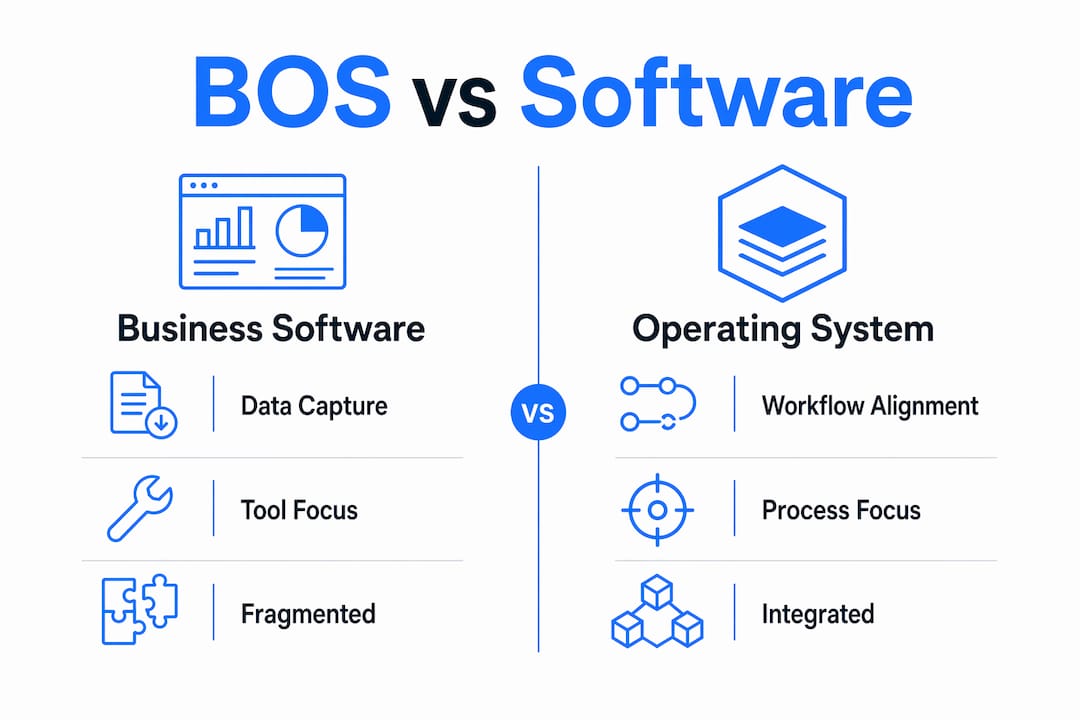
Many entrepreneurs make the same mistake: they buy a new tool and call it their operating system. A CRM like HubSpot tracks contacts. A project management tool like Asana tracks tasks. Neither one tells your team who owns a decision, what the escalation path is, or how performance gets reviewed on Friday morning. That gap is exactly where businesses stall.

| Feature | Business software (CRM, PM tools) | Business operating system |
|---|---|---|
| Primary function | Data capture and task tracking | Workflow coordination and governance |
| Accountability | Assigned tasks | Defined ownership and decision rights |
| Reporting | Activity metrics | Trusted operational dashboards |
| Meeting structure | Ad hoc or tool-driven | Fixed cadence with structured agendas |
| Scalability | Scales data volume | Scales decision-making and execution |
The distinction matters because relying solely on tools produces fragmented processes. You end up with data in five places, accountability in none, and a founder who has to manually connect the dots every week. A BOS wraps around your tools and gives them context, ownership, and rhythm.
Pro Tip: Audit your current tools by asking one question: does each tool have a named owner and a defined review cadence? If not, you have software, not a system.
What are the popular business operating system frameworks?
Several well-established frameworks give entrepreneurs a proven starting point for business system management. Each takes a different angle on structure, metrics, and meeting cadence.
EOS (Entrepreneurial Operating System) from EOS Worldwide is the most widely adopted framework for small and mid-size businesses. Its core tools include the weekly 90-minute Level 10 Meeting with a fixed agenda and a Scorecard that tracks 5 to 15 leading indicators with clear ownership and weekly goals. The Level 10 Meeting is designed as the heartbeat of the company, driving accountability and surfacing issues before they become crises.
The Fractional COO approach, articulated by practitioners like Simon Wakeman, focuses on founder independence through structured delegation. It treats the BOS as the mechanism that allows founders to hand off decisions safely, not just tasks. This framework is particularly relevant for entrepreneurs who are the bottleneck in their own business.
The Danaher Business System (DBS) operates at the enterprise level and functions as a culture driver as much as a process framework. Danaher uses DBS to embed continuous improvement into every layer of the organization, making it less a meeting cadence and more a management philosophy.
| Framework | Best for | Core mechanism | Metrics focus |
|---|---|---|---|
| EOS | SMBs and scale-ups | Level 10 Meeting + Scorecard | 5 to 15 weekly leading indicators |
| Fractional COO model | Founder-led businesses | Delegation structure and decision rights | Founder independence metrics |
| Danaher Business System | Enterprise organizations | Culture of continuous improvement | Operational and quality KPIs |
The EOS Scorecard is worth highlighting separately. It deliberately limits metrics to a small number of weekly leading indicators, which is the opposite of a traditional dashboard loaded with lagging data. More metrics are not better. The right subset, tracked weekly in a fixed cadence, surfaces problems early when they are still fixable.
How to implement a business operating system effectively
A phased 90-day approach is the most reliable way to install a BOS without disrupting current operations. Here is how to structure it:
-
Map your core workflows. Start with the three to five workflows that drive revenue and delivery. Trace each one from the first customer touchpoint to the final deliverable and identify every handoff point.
-
Select 5 to 10 KPIs per team. Resist the urge to track everything. Choose leading indicators that signal future performance, not just lagging metrics that confirm what already happened. Assign a named owner to each number.
-
Audit your current meetings. List every recurring meeting in your business. Identify which ones produce decisions and which ones produce updates. Eliminate or redesign the ones that produce only updates.
-
Design your meeting cadence. Build a weekly rhythm that mirrors the EOS Level 10 structure: a fixed agenda, a Scorecard review, and a dedicated issue-solving segment. The meeting and ownership loop is the accountability engine of the entire system.
-
Roll out in phases. Start with leadership, then cascade to team leads, then to individual contributors. Give each phase 30 days to stabilize before expanding scope.
-
Build standard operating procedures for critical steps. Document only what is genuinely repeated. SOPs for one-off tasks waste time. SOPs for weekly recurring processes create compounding reliability.
Effective BOS implementation starts with a limited set of critical workflows and KPIs before expanding. Founders who try to install the full system in week one almost always abandon it by week six. Restraint in the early phase is what makes the system stick.
Pro Tip: Run your first Level 10 Meeting with only your leadership team and a single Scorecard. Nail the cadence before you add complexity.
What benefits does a business operating system bring to entrepreneurs?
The tangible advantages of adopting a BOS compound over time. Here is what changes when the system is working:
- Founders stop being the bottleneck. A BOS turns founder-dependent decisions into founder-independent execution by embedding decision rights into the system itself, not into one person's calendar.
- Operational reliability improves. When workflows are defined and owned, delivery becomes predictable. Clients notice. Retention improves.
- Leadership gets trusted data. A well-designed reporting layer means you stop managing by gut feel and start managing by signal. You see problems in the Scorecard before they show up in revenue.
- Team accountability increases. When ownership is explicit and reviewed weekly, people step up. Ambiguity is the enemy of accountability, and a BOS eliminates ambiguity by design.
- Growth becomes sustainable. Businesses without a BOS grow until the founder breaks. Businesses with one grow until the system needs upgrading. That is a fundamentally different and better problem to have.
The benefits of a business operating system are not theoretical. They are the direct result of replacing informal, founder-dependent coordination with a structured, repeatable system that works whether you are in the office or not.
Key takeaways
A business operating system works because it replaces informal coordination with structured workflows, defined ownership, and a fixed meeting cadence that drives accountability at every level.
| Point | Details |
|---|---|
| BOS is not software | A BOS integrates workflows, governance, and ownership around your tools, not inside them. |
| Ownership drives reliability | Explicit decision rights and handoffs prevent workflows from breaking during growth. |
| Meeting cadence is the engine | A fixed weekly rhythm like the EOS Level 10 Meeting is what makes accountability real. |
| Start small and expand | Map three to five core workflows and select limited KPIs before scaling the system. |
| Founders become optional | A functioning BOS turns founder-dependent decisions into team-owned execution. |
Why most entrepreneurs install tools when they need a system
I have worked with enough founders to recognize the pattern immediately. They buy a new CRM, set up an Asana board, maybe add a Notion wiki, and then wonder why nothing feels organized six months later. The tools are fine. The problem is that no one defined who owns what, how decisions escalate, or what gets reviewed on Monday morning.
The uncomfortable truth about business system management is that the hard part is not the technology. It is the discipline of defining ownership and holding a weekly meeting with a fixed agenda, every single week, without skipping it when things get busy. That meeting is exactly when you need it most.
I have seen founders resist the EOS Level 10 Meeting format because it feels rigid. Three months in, those same founders call it the best hour of their week. The structure is not a constraint. It is what makes the hour productive instead of circular.
My advice: do not wait until you feel ready to implement a BOS. You will never feel ready. Start by mapping one workflow and picking five KPIs. Run one structured meeting. Build from there. The system does not need to be perfect to be useful. It needs to be consistent.
— james
Build your operating system with Firstboroughconsulting
If you recognize the gap between where your business runs today and where a structured operating system could take it, Firstboroughconsulting is built for exactly that transition.
First Borough Group LLC works with digital entrepreneurs who want to scale without becoming the single point of failure in their own business. Their frameworks, playbooks, and strategic kits are designed to install the structure of a BOS without the overhead of a traditional consulting engagement. Whether you are mapping your first core workflow or redesigning your entire meeting cadence, First Borough Group gives you the blueprint to run your business like a system, not a solo act.
FAQ
What is a business operating system in simple terms?
A business operating system is a standardized set of workflows, ownership rules, and meeting cadences that align your team's daily work with your company's strategic goals. It is the framework that makes your business run without depending on one person to hold everything together.
Is a business operating system the same as business software?
No. Software tools like HubSpot or Asana are components that a BOS can incorporate, but the system itself is the structured layer of workflows, governance, and decision rights that coordinates how those tools are used and who is accountable for outcomes.
What are the most common types of business operating systems?
The most widely used frameworks include EOS (Entrepreneurial Operating System) from EOS Worldwide, the Fractional COO model focused on founder independence, and the Danaher Business System used at the enterprise level. Each differs in meeting structure, metrics focus, and implementation scale.
How long does it take to implement a business operating system?
A phased 90-day implementation is the most practical approach for small and mid-size businesses. The first 30 days focus on mapping workflows and selecting KPIs, the second on designing the meeting cadence, and the third on rolling out to the full team.
What is the biggest benefit of a business operating system for founders?
The primary benefit is removing the founder as the bottleneck. A functioning BOS embeds decision rights and accountability into the system itself, which means the business executes reliably whether the founder is present or not.